
Women initiate 69% of divorces. Among the most empowered (college-educated) women, it’s 90%. Why though are women who driving so much of modern divorce?Commenting on my article about why women always seem to go for the wrong guys, Vince C. asks
Chase, overall I certainly agree with most of what you're saying here but I think there should be a follow up article to this.
Because I'm genuinely curious, why is the divorce rate hovers close to 50% if many girls believe they are choosing the right guy for themselves, later to find out that this was in fact not the case?
A reader named Montage replies to Vince, noting that
Back in the day, a researcher looked at the divorce rate, concluding it was actually around 33-35%. The 50% figure was supposedly inflated by "serial divorcees."
I'm not sure why you're exclusively blaming women, though. What about the guys who filed for divorce? Some of them assumed they had found "Ms. Right," only to end up wrong. Other men marry their first wife for pure economics. Once a dude's career has taken off, he drops her for a trophy wife. I remember some guy did exactly that. Once his first wife had helped him graduate from schools of both law & medicine, he ditched the poor woman. He's no longer with us, and she's doing life in prison.
Another issue you're overlooking is that women's market value is mostly attractiveness/youth. For that reason, many will marry out of a fear of ending up as a spinster/weirdo, or out of a fear of life on one income, not because they feel they've found somebody special.
We know divorce happens.
We know it doesn’t always happen.
In India in 2024 the divorce rate was 1%.
In the United States in 1924, 100 years ago, the divorce rate was 14.4%, which is about a quarter what it is today. The U.S. was already the world leader in divorce at this point (and had since 1916).
Yet if you go all the way back to 1867 in the United States, the earliest date we have reliable data for, the American divorce rate was just 3%, not very much higher than India’s in 2024.
You can see how divorce rates have changed over the years in the U.S.:
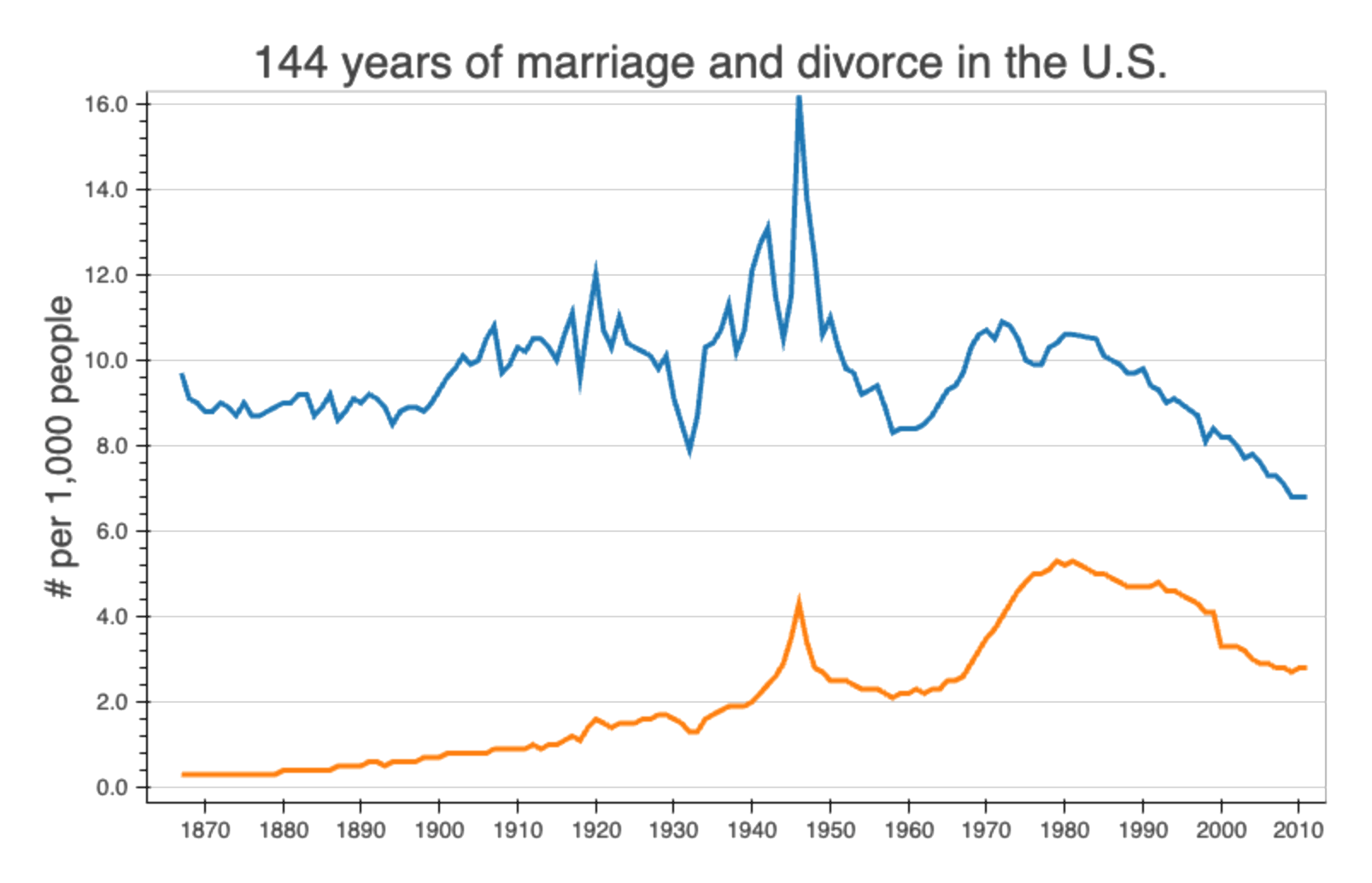
U.S. marriage & divorce rates, 1867-2010Obviously, we are looking at something highly variable over time.
Women initiate 69% of divorces overall. However, among women with the greatest amount of personal liberty – that is, college-educated women – women initiate a jaw-dropping 90% of divorces.

What Is Marriage For?
To understand this puzzle, let’s start at the beginning:
The entire point of marriage.
If you examined marriage in the modern West right now, you would conclude that:
-
It is primarily a legal contract.
-
It gives people moderate tax breaks.
-
It is engaged in for emotional reasons (i.e., ‘love’).
-
It is a guarantor of continued access for the woman and any children to the man’s resources in the event of a dissolution.
… and that is really it.
There is no honor in marriage. No respectability it confers anymore. People are not expected to marry and many don’t. There’s nothing shocking about older unmarrieds.
If you turn the clock back a century, unmarried Western men and women alike faced lots of social pressure to marry. Divorce, while not rare, was nevertheless a black mark on one’s card. It was a sign of someone who had failed at one of life’s most important milestones.
I’ll use the U.S. as the base of my comparison here. But you will be able to find similar parallels in any Western nation.
Compared to American marriage in the 1920s, American marriage in the 2020s is a pale shade of its former stature. It’s mostly a formality. Generally at the time of marriage the couple has already been living together anyway! They throw a big party and sign a contract to make it ‘official’. Then they return to right what they were doing before they wed.
While it was more substantial then, marriage in the 1920s in the U.S. had in turn already crumbled much in its significance!
150 years earlier, in the 1770s, marriage had been a rational affair, where the future spouses talked about logical reasons they were a good match. Families weighed in to encourage or bar a union. Marriage was a religious and cultural ceremony first and only.
A Puritan couple in 17th Century New England.In the late 18th Century, ‘love marriages’ became increasingly common. By the mid-19th Century, marrying for love had become as good a reason to marry as marriage for logical reasons. Love was expected to be half of why a couple wed. (today, of course, if you marry for any reason besides love, Americans consider you ‘cold hearted’ and the marriage something entered into for the “wrong reasons” and destined “not to last”!)
It actually wasn’t even until 1913 that the U.S. federal government even recognized marriage under law!
(under American President Woodrow Wilson – whose presidency was also responsible for the creation of the U.S. Federal Reserve, the IRS and income tax, U.S. entry into World War I, enactment of women’s suffrage, and the founding of the precursor to the United Nations. We could well say Wilson’s was the most impactful presidency in U.S. history; it set the U.S. on a very different historical arc than perhaps it otherwise might have had)
Before 1913 in the U.S., marriage was a primarily sociocultural-religious institution.
Marriage in the past served these functions:
-
To provide for childrearing.
-
To afford the woman provision and status.
-
To afford the man a helpmate and status.
-
To unite two families together.
Imagine telling those things to your average modern young American. He or she would be horrified! How outmoded! How oppressive! How sexist!
Yet, stripped of its functions, marriage has become an increasingly vestigial institution.
Consider the case of polygynous marriage vs. homosexual marriage. Both were outlawed in the U.S. until recently. One (polygynous marriage – where a man takes more than one wife) remains illegal. But the other (homosexual marriage – where two men or women of the same sex wed) is now both legal and celebrated.
Under the old functions, there’s a pretty reasonable argument for polygynous marriage, and none at all for homosexual marriage. But under the new functions, there’s arguably a stronger argument in favor of homosexual marriage than there is for polygynous marriage – so that’s what we get: infertile unions celebrated, while supra-fertile unions are outlawed.
When you consider it in this light, it makes clear that ‘marriage’ has shifted in an increasingly sterile, barren direction in the Western world.
Men and women still engage in it, and still produce children in it.
But they are far less fecund now, and their marriages far less lasting.
If marriage no longer hews to its old raison d’être, does it even have relevance anymore?
Marriage as a Cultural Vestige
If you’d have asked a man and woman in 1770 why they wanted to marry, they could have given you a long list of cogent reasons:
-
Reasons why their two families would work well together united.
-
Reasons why the man and woman marrying were compatible.
-
That they intended to start a family and wanted a safe environment to raise children in.
-
That they were adults now and were ready for the next stage of adulthood.
Of these, #s 1 and 3 have clear PURPOSES (unite families; produce & rear children) whereas #2 is merely a justification for why these two people in particular should marry (but is not a justification for marriage itself); meanwhile #4 is mindless cultural conditioning (“That’s just what an adult must do!”).
If you ask a man and woman today why they want to marry, their reasons will be these:
-
“Because we love each other.”
-
(optional) “Because we want to start a family.”
These reasons are both flimsy arguments for marriage, because marriage is unnecessary for either. For instance:
-
If they love each other, and that’s the reason for marriage, why didn’t they marry their previous girlfriends/boyfriends? Did they not love them too?
-
If they want to start a family, who needs marriage? Many children are born to unmarried parents these days. There’s very little social stigma attached to it anymore.
If you say these things to them, they will give you vague mutterings about “it’s because we want to be together” or “well, there are tax incentives.”
The true underlying reason that almost everyone who marries today marries, if you get right down to it, is because they feel that they are ‘supposed to’. It is, like the #4 reason for the 1770s adults, mindless cultural conditioning – except that in today’s world, there is often no reason for marriage besides mindless cultural conditioning.
21st Century Western thinking on what makes a marriage a success.(that is not to say you should not marry. There are still valid reasons for marriage today. There is even a justification for “I don’t care about it at all but my woman needs it so I’ll go along with it.” Cultural conditioning is a mighty force – if someone has been programmed deeply to want and need marriage, and is unable to get it, that is very likely to END the relationship, even if everything that person wants and needs marriage for – financial security, reproduction, etc. – is attended to)
In essence, though, today, marriage is a cultural vestige.
It’s not needed. It is not needed to:
-
Unite families in business, assets, or politically (few do this anymore)
-
Achieve good adult social standing (very little impact on this anymore)
-
Produce and raise children (while two-parent households do lead to better outcomes on average for children than single-parent households, many children are raised in single-parent homes, and many of those children still turn out fine)
The main reason people get married in the West today is “because it feels like I should.”
Yet with reasons so flimsy, it’s a miracle anyone marries at all – or that as many marriages endure as do.
It is not surprising, on the other hand, that marriage as an institution is failing, and that marriage rates fall farther and farther every year. The longer it remains the purpose-light, vestigial institution it has become, the less and less appeal it will have to future generations (who are farther and farther removed from when marriage had real purpose in one’s life) – until at last it has no appeal at all.
If Marriage Isn’t Needed, Divorce Becomes Appealing
When I was in university, my Chinese roommate told me about the relationship of his parents. His mother had separated from his father many years ago, due to the father’s philandering. Every now and again they’d tried to reconcile, but the mother would ultimately leave the father in disgust again after catching him with yet another mistress. Yet although they’d remained separated for many years, they never divorced.
I thought this was an odd scenario, but shrugged it off as a sort of one-in-a-million outlier.
Then I began traveling the third world.
As I talked to people, I encountered couple after couple where the husband and wife had separated years or decades ago, lived in completely different part of the country or different countries entirely, and clearly were not ‘together’ in any real sense of the word. Yet none of them had divorced.
As I read books from the early 20th Century or before, I began to notice every time I encountered a couple like this, in fiction or in nonfiction. Many of these couples existed in American and European history too! Why would these couples separate, live apart for years or decades, yet never divorce?
So I discussed this with young unmarried women in the third world, who were in these cultures, about if they would ever divorce their future husbands if things did not work out between them. I heard things like this:
-
“If it did not work out between my husband and me, I would not want another husband. I would not want divorce. I would just go and live alone by myself.”
-
“If I get married, I only want to get married once. I will never divorce. If I can’t make it work with my husband, then we will just separate. I will not remarry so I don’t need a divorce.”
When I talked about it with unmarried third world men, they usually implied if they had to separate from their future wives, they could always get their sexual needs met with prostitutes, who are ubiquitous in the third world, so there’s really no need to go to the trouble of divorcing and remarrying.
It became clear that in societies like the third world today or the America and Europe of yesteryear:
-
People only want to marry ONCE.
-
Marriage confers social status. Even a separated marriage does this.
-
Divorcing is a disgrace. It is a personal failure, and marks one as low status.
-
Because people don’t marry for ‘love’, they also don’t need to remarry. They aren’t running around seeking people to ‘fall in love with’ and marry those people, like modern single and divorced Westerners are.
On that last point: it is not uncommon in ‘anti-divorce’ societies to have a pair of long-term separated men and women, both married to other people, living with one another like husband and wife. Ever hear of Benjamin Franklin, Founding Father of the United States? His first child was fathered out of wedlock; his next two he sired with his common law wife, whom he could not marry because she was married to (but separated from) someone else. There are many instances such as these in societies where divorce is legal but rare or else legally difficult/impossible.
Due to American traditions around personal liberty, by the mid-19th Century U.S. courts were granting more divorces than all of Europe. For comparison, Europe’s population in 1850 was 226 million; the United States’s was 23 million, less than 10% the size.
It was the woman’s suffrage movement – the precursor’s to today’s feminists – who were the most vocal advocates in favor of loosening divorce laws. The National Woman Suffrage Association included divorce reform in its advocacy as early as 1869, though it was the National Association of Women Lawyers that saw to the creation of Family Law courts and pushed no-fault divorce law beginning in 1960. Prior to then, spouses suing for divorce had to show a fault in the other spouse: abandonment, cruelty, incurable mental illness, or adultery. Without a reason, divorce would not be permitted. If both husband and wife were guilty, divorce would not be permitted. Once no-fault divorce laws began passing from 1969 on, America’s divorce rate – already the highest in the world – simply exploded.
But this brings us back to the premise of this article: it was women’s organizations that pushed so hard to take the fetters off divorce. Why?
Why Are Women So Fixated on Divorce?
First off, we know men file for plenty of divorces themselves.
Yet we also know that among the most empowered women – college-educated ones – the rate of divorcing done by women reaches 90%.
We know that modern lax divorce laws come as the result of women advocating for them – from suffragettes to women lawyers.
Obviously, women would like to have the option to divorce (and take a fair share of the marriage’s property with them, thank you very much!).
This is not the only thing like this in law. Women are the ones who created ‘consent theory’ in the 1970s (thanks, Susan Brownmiller!) and have completely reframed the discussion of heterosexual sex around the previously non-existent concept of ‘sexual consent’. Women are also the ones who have pushed so hard for the legalization of abortion. Even today, in 2024, abortion is the #1 political issue for women under 30.
Women sure are enthusiastic about letting men knock them up and then aborting their babies, aren’t they?I saw a joke recently about how women pushed so hard for the vote claiming that with women voting it would be a kinder world; yet now that they have the vote, their top political issue is being able to kill their children! It’s a flippant way to put it, but it hits upon a deep truth in women’s political advocacy. Look at all the political positions women consider to be the MOST important:
-
Women want to have the ability to back out of a marriage and obtain a divorce, regardless what the man wants.
-
Women want to have the ability to back out of a pregnancy and obtain an abortion, regardless what the man wants.
-
Women want to have the ability to back out of sex with a man at ANY point up to and including once back at the man’s apartment kissing and touching with him and even in the midst of the sex act itself – and punish him with a rape charge if he does not rapidly and happily comply.
It all starts to make sense when you recall “a woman’s prerogative”:
Changing her mind is a woman’s prerogative.
This, ultimately, is what women’s issues boil down to when you strip away the window dressing:
The ability to change their minds at any time regardless what anyone else might want!
In a society like ours, where men yield to women, women will naturally push for more and more power to change their minds and face no consequences.
This is what women do, whenever and wherever in time and space that men allow it.
The men of Western society, for reasons known only to them, have decided to allow it.
Why Women Change Their Minds on Men (and Decide to Divorce)
We’ve cast a wide net.
Let’s reel it back in.
When a woman divorces a man, it is rarely because “she chose wrong.”
She will tell you she “made the wrong choice”:
-
“I never should have chosen my husband.”
-
“I was young and naïve.”
-
“I didn’t realize who I was marrying.”
-
“I didn’t expect how he’d change after marriage.”
But women always claim they ‘picked the wrong guys’ – it’s ‘cover logic’.
It’s true, we are often naïve when younger. The old chestnut about men and women marrying and their expectations holds steady:
A woman marries a man thinking he’ll change, but he never does.
A man marries a woman thinking she’ll never change, but she always does.
The stark reality, the vast majority of the time, is not that the woman ‘picked wrong’ but that she changed her mind. She changed it, and the man was unable to change it back.
Women always change their minds. They change them constantly. Every seducer reading this website who is intermediate or above in his skill with women knows this. It doesn’t matter if she tells you “we are not having sex tonight”; you likely still will. It doesn’t matter if she tells you “I’ll never date you”; you can get her to. It doesn’t matter if she tells you “I won’t date a man who isn’t exclusive to me”; if your frame is firm, and your value to her is high, she will.
Women change their minds in long-term relationships, too. The ‘grass is greener on the other side’ effect starts to kick in:
-
They realize they married a guy who made them feel cherished and safe, but now they’re starting to feel a little bored. And wouldn’t it be nice if they were with an exciting guy?
-
Or they realize they married the fun, sexy guy, but he’s always struggling to pay the bills and life with him is just TOO stressful. Wouldn’t it be nice if they had a guy who could offer them a stable life – maybe even a little extra spending money and some nice things here and there?
Those are just two examples. There are all kinds of ‘grass is greener’ triggers.
When a woman starts to realize this, she will cause drama. And the man will either handle it, or he won’t.
Many men look at marriage and assume it’s forever.
It’s not forever.
Not in the early 21st Century West.
There are no laws in place to enforce that; no cultural stopgaps to keep it together.
Women always change their minds and if a man cannot keep his woman satisfied, and there are no legal or cultural forces to keep them together, she WILL LEAVE!
All those marriage laws to keep people from divorcing were not in place to stop men from leaving. They were there to stop women from leaving!
That’s why it was the National Woman Suffrage Association in 1869 and the National Association of Women Lawyers in 1960 that pushed hardest for divorce. Women want the right to change their minds.
“Am I sure Jim is still the right one for me?”Women don’t do things ‘forever’. They do things ‘for right now’.
They will TELL you they want it ‘forever’ — right now in the moment. Later, when things change and they are feeling differently, that may no longer be the case.
Women make decisions based on what feels good to them right now. What feels right.
To men, this seems fickle, BUT REMEMBER:
-
Women are the ones who invest most heavily in incubating, breastfeeding, and nurturing infants.
-
They continue to be the ones who invest most heavily in rearing children to adulthood.
Women need to be especially attentive to signs a man
-
Is not providing as excellent genes as she’d thought – in which case, she does not want to be stuck there bearing more of his children, instead of another, superior man’s – or
-
Is not going to provide a suitable environment for the rearing of their children, or (perhaps worse) may abandon them or leave.
She needs to keep her ear to the ground.
Because while men don’t really ‘change’, men do very much seek to put their best foot forward with women – and often don’t actually show women their true colors until (sometimes much) later on:
-
Men may pretend to be confident up front, but actually have deep-seated insecurities, problems, and weaknesses.
-
Men may pretend to be financially well-off, but it’s borrowed money and one day the bills come due.
-
Men may pretend to be interested, loving paramours, but that’s only to capture the women, and once they have them they show their true stripes as neglectful, disinterested workaholics, philanderers, or both.
If a woman gets even a whiff of this, she will start to test the man with drama.
If the man can HANDLE that drama, and put her back in her place, she WILL settle down! It shows her she was ‘wrong’ in her doubts about him; in fact, he is the man she wants to be with. She wants to be with a man who can handle her!
If he CANNOT handle that drama, her doubts will be confirmed, and she will change her perspective on him. At that point, she starts to conclude she “had him wrong”, “got the wrong idea”, and so on – and then, in a society where she is free to divorce and faces little consequence for it, she starts to think about divorce.
I will also add, in reference to Montage’s reply at the start of this article: lax divorce laws and low/no social stigma offer men encouragement to divorce as well. If a man is able to say to himself, “Well, she’ll be all right without me. She’ll find another guy no problem,” he is not going to feel as bad about ditching her – especially if her demands and theatrics have gotten too much for him, or the grass on the other side looks much greener, as with Montage’s example of a homely girl who put her man through school, only to be dropped for a younger and hotter model once he’d made it. Once again, keep in mind though: the higher the woman’s economic and social power, the more likely it is that if there’s a divorce, she’ll be the one initiating it!
Tigers Don’t Change Their Stripes
A man is the man he is.
But we all AIM to look more appealing to women.
It is the truth of men that we puff ourselves up, make ourselves look more charming, more competent, more worldly and capable, as we court a woman we want.
A man might say, “Not I! I’m never anything but 100% honest with a lady!” but go visit him five years into marriage and compare that frazzled, overweight, stressed out, dismissive version of him with the active, charming, confident, interested self he showcased during the courtship. Settled life robs every man (and woman) of some of their charm, but if too much of it rubs off, a woman is naturally going to wonder which man was the real him – the charmer he was or the oaf he’s become.
Most men present themselves as fairly ambitious, fairly determined to be successes, but few men ever reach their highest ambitions, and many men fall far short. If the woman believed the dream he was selling, but the dream never comes true, it gives her cause to reassess. Truth be told, it’s often impossible to know in advance which men will hit their marks and which will fall short; no man yet has devised a surefire formula for predicting who will be a success. If he had, surely women would all be using it to gauge the men they want to marry!
In the modern Western world, with no legal restrictions barring divorce, no cultural stigma tied to it, and marriage itself having little real use anymore aside from the vague sense of “it is just what people do”, there’s little to stop the flood of women changing their minds at some point and deciding they want out.
Without legal restrictions, without cultural stigma, the only stopgap to a woman divorcing a man is the man himself. Is he able to handle her, to put down her drama, to put her in her place, or not?
That is why I have so many articles on Girls Chase teaching men how to run relationships properly. There is no force on Earth other than YOU who can keep your woman in a relationship with you today. The state won’t help you. Society won’t help you. Her family and yours won’t help you. Some of these forces will even actively oppose you. But if you can run a good relationship, if you understand the psychology of women, if you can handle women’s tests and drama and come out on top without breaking, you can have whatever kind of relationship you want, for howsoever long you want it.
In times that are easier for men, where society is arrayed in support of them, lesser men are able to retain their women in marriage; even if the woman loses respect for the man, even if the sex dries up, even if the pair stop talking or separate and remain apart for decades.
But in today’s wild, anarchic, freewheeling times, the only force that can keep a woman with a man is that man himself.
Society will not help you. Only you can keep your woman.If you want something lasting with a woman, you must take up this challenge: take responsibility for your own relationships, full in the knowledge that it is you and only you who can determine their outcome – and enjoy relationships where not only the woman remains with you, but she does so of her own free will, because being with you is better than anything else she might freely choose to do.
Yours,
Chase Amante
READ NEXT: “Modern Marriage, Part 1: Why the Heck Do Guys Get Married?”


SHOW COMMENTS (1)