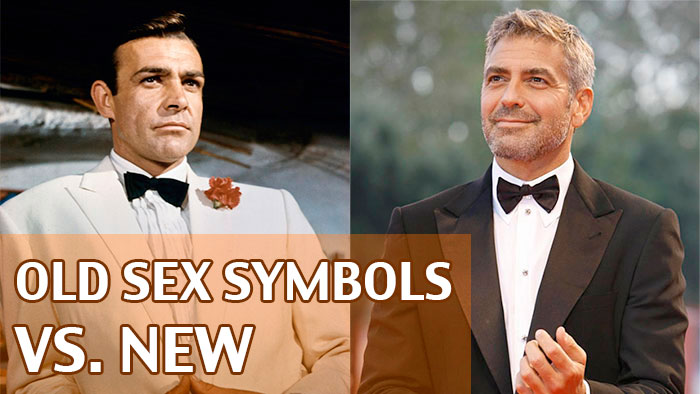

I previously said (in this post) my next article would be “How to Be an Alpha Provider”... however, I’m going to switch things up today. Today’s article is about sex symbols: those of the past and those of today. And we’ll get back to the alpha providers again next week. Onwards, then.
Today’s article comes in response to a question from Byron on my article about self-cultivation regarding my preference for older male sex symbols over the more current ones Hollywood has to offer. Here’s what Byron had to say:
“Hey,
I’ve recently come across several comments where you reference Sean Connery and Harrison ford as the epitome of raw sexiness. I was wondering if you could elaborate on this and why not the plethora of modern sex symbols, ie what makes them so different? Or if you could write an article on their appeal or a series on famous seducers/ role models I think that would be very interesting and relevant. Again just suggestions, I realize you are very busy. Thank you for this site!”
That’s a fantastic question. Why do I recommend the older guys more than the newer guys? I had a few reasons, but part of me kind of wondered if maybe I just had some kind of nostalgia-bias when this subject’s come up in the past... maybe I’m simply guilty of thinking older is better.
Fortunately, this article’s forced me to really get down to nuts and
bolts, and in the process of writing it, I learned a lot. Let’s dive in.
Think about your old school, old fashioned male sex symbols. Men like:
- Gary Cooper
- Cary Grant
- James Garner
- Sean Connery
- James Dean
- Harrison Ford
Compare them to the sex symbols of modern cinema. Men like:
- Brad Pitt
- Ryan Gosling
- George Clooney
- Ian Somerhalder
Do you notice anything?
I like all the guys in both of these lists. All are masters of their crafts, and there are buckets you can learn from watching the facial expressions, body language, and little nonverbal tics of each, as well as studying the way each man uses his voice and his overall demeanor.
However, there’s a clear difference between these two groups of men
(that span about two generations each)... a large enough difference
that while I personally suggest you take the time to study all of these
men, when it comes to my own preferences, the only ones I ever find
myself wanting to model outright are the ones from before.
And I sat down today and the one question on my mind was, “How do I best explain this difference?”
Cooper vs. Gosling
Let’s compare, say, Gary Cooper with Ryan Gosling. Here’s Gary
Cooper:
... and here’s Ryan Gosling:
Both men have a lot of great things going on. Both have excellent fashion, great facial expressions, body language, and good dialogue. And of course, the roles you examine them in are important (e.g., I didn’t use the a trailer of Gosling’s The Nice Guys film because it has him screeching a bit and doing other unmanly things that’d set up a clearly unfavorable comparison).
That can make pinpointing the differences a little hard.
So, here’s some help: watch both of these clips a few more times, and each time keep an eye out for one of the following qualities:
- How rapidly the subject’s facial expressions change
- How much head movement he uses when speaking or listening
- How much time he spends focused on others during the scenes
- How clearly articulated his words are (or if they slur together at all)
- How sincere his eye contact and comportment come across
- Whether and how he challenges or calls others out
You’ll notice some big differences in each of these qualities:
- Cooper’s facial expressions change less frequently and more slowly
- Cooper’s head is mostly still, while Gosling’s jerks about like a bird’s
- Cooper frequently looks away, pondering, while Gosling is focused on others
- Cooper’s words are each neatly articulated, while Gosling’s often run together
- Cooper’s eye contact and demeanor make him seem more genuinely warm
- Cooper is blunt-but-short in his verbal challenges, while
Gosling’s are spiels
Overall, I get the impression from both men that Cooper is the tougher, stronger man, yet he’s also the more caring and considerate man, and he’s prone to thinking more deeply and not always necessarily listening to whatever others are trying to tell him. Conversely, Gosling comes across as having jerkier, more changeable body language, which signals lower status (relative to a Cooper), and he’s also far more guarded and less open with warmth and sincerity. Gosling also wades into long critical speeches, something Cooper simply wouldn’t do, which is funnier but at the cost of making him a more annoying, less likable character.
Note that some things, like shrugging eyebrows or eyes darting about, that you might consider ‘more feminine’ are things both men do for comedic effect and to make their points. Also notice that while Cooper moves his head much less often than Gosling, when Cooper does move his head, he tends to move it about the same speed. And both men spend a lot of time not smiling, with their ‘serious faces’ on, though Gosling also uses the ‘cute & sexy look’ a lot (from the facial expressions article), which Cooper does not use.
Anyway, the end result for me is I compare men like this, and I feel
like Cooper is the stronger, more solid, more thoughtful man, who
actually fills the shoes of a leader (or ‘alpha male’), while Gosling
comes across as the more hurried, selfish, and opinionated man who
comes across more as a nomad or sigma male than one
suited to a mantle of leadership. Gosling may actually be at an
advantage over Cooper in a quick hookup situation (then again, the
head-bobbing, criticism, and over-attentiveness hurt him here relative
to Cooper, as well), but he probably does worse in all other scenarios.
Connery vs. Clooney
Clooney is the closest we have among the current crop of leading male sex symbols to the stronger qualities of the men of bygone Hollywood generations. Choosing whom to pit him against was a tough call... I considered James Garner, Sean Connery, and Harrison Ford for this comparison. My initial thoughts were:
- Garner is both manlier and has a wrier sense of humor than Clooney
- Ford growls and broods his way into making Clooney seem too slight
- Connery though, he’s a bit wrier than Clooney, but otherwise,
they’re close
So I opted for Connery here, since I thought that’d give Clooney his most even match.
Here’s a clip of Sean Connery in his prime:
... and here’s George Clooney:
First off, I must say this is a much tougher comparison than Cooper and Gosling. Cooper beats Gosling by a mile in my opinion, while Clooney gives Connery a run for his money. In fact, I’d go so far as to say Clooney probably modeled himself to large extent after Connery, and if so, he made an apt pupil. There are a lot of parallels:
- Wry sense of humor
- Similar facial expressions
- Similar guttural, resonant, purr-filled voices
However, some differences do pop out. Watch each clip again, this time keeping an eye out for the following things:
- Who has more goofy, excitable expressions vs. who is more stoic
- Who seems to experience more emotional swings vs. who’s more collected
- Who is more physical and forward with women
- Who has greater physical proximity with those around him
- Who’s quicker on the draw when it comes to witty remarks
The distinction ends up being:
- Clooney makes more goofy, excitable expressions
- Clooney’s emotions are more variable, while Connery is always in control
- Connery is more physical/forward with women, while Clooney is more guarded
- Connery gets closer to people, while Clooney maintains more distance
- Connery’s remarks spring right out, while Clooney has a lag/filter
Clooney’s manlier than a lot of modern men are, and there’s still plenty to learn from him.
But in the end, if you ask me, he’s a poor man’s Sean Connery.
For the Younger Guys
I know there are a bunch of guys on our discussion boards who really like Ian Somerhalder. I’ve always liked him a lot too – I’ve never seen Vampire Diaries (aside from the clips below), but his was one of my favorite characters in the first season of Lost.
That said, compare James Dean to Somerhalder. Here’s Dean:
... and here’s Somerhalder:
I’m not going to pick everything apart here, but instead just point out some of the items that stood out to me most:
-
At first, I’m torn between Dean’s raw emotionalism, which initially seems a little immature, and Somerhalder’s smarmy self-confidence, which seems forced
-
However, there’s a rawness to Dean’s portrayals that really make you feel like here’s a guy that’s being totally open and sincere about his inner world (and emotions running high is pretty normal for your late teens to early/mid twenties), while Somerhalder’s smugness makes him seem, like Gosling and Clooney, more guarded. It also seems rather unnatural for his age – being that young and inexperienced, you don’t know everything about the world yet, and hormones are running high... he acts like he’s deliberately keeping the damper on
-
And once Dean starts talking about why he’s emotional: he’s got to know who he is, it’s about honor, etc. It’s not just the subject matter (which is only due to the script), but about how the sentiment is conveyed... Dean conveys these very vulnerable messages in a powerful “I am going to figure this out” way... whereas, having seen a fair bit of Somerhalder’s work, I have trouble picturing him delivering lines like this without coming off at least a bit whiney
-
And of course there’s their interactions with women; Somerhalder sits around and listens in and does funny facial expressions as women talk about him, while if Dean was in that situation, you can be sure he’d get up, walk over to the women, rest his arm on the cupboard above their heads, stare at one of them and grin, or even yank her into him. Somerhalder also makes jokes about sex later (“No, Elena, I will not go to your bedroom with you!” [this is not chase framing, by the way, for several reasons]) when he should be proposing something – can you imagine Dean joshing when he should be smoldering all over her or taking action? Neither can I
Like all the men in this article, still tons you can learn from Somerhalder.
However, if I’ve got to pick just one of these two, it’s again going to be the guy from a few generations back.
Major Themes: Earlier Sex Symbols vs. Modern Ones
Let’s highlight all the similar themes running through these comparisons.
-
Personal space: one of the big ones is physical proximity. The men from earlier generations get much more into the space of those they interact with. The more modern men position themselves farther away. This is certainly more respectful and polite, but the price is connectedness, trust, and sincerity. Not so good a trade, if you ask me.
-
Guardedness: this was one of the BIGGEST themes from this analysis that I noticed. I was not consciously aware of this distinction before I sat down to do this article. But isn’t it amazing how less guarded the men of earlier generations appear? With women, with other men, even when talking to themselves. Cooper and Dean show real, raw, yet masculine emotion, while Connery always remains in control, yet completely honest. Gosling and Somerhalder constantly strike me as self-conscious to some degree, while Clooney is more comfortable in his skin, yet still more guarded than sex symbols of a bygone Hollywood.
-
Exaggeration: Gosling nods his head about like, well, a gosling (i.e., a baby goose), Clooney uses a bunch of goofy facial expressions that make him amusing but strip him of some of his masculinity and sex appeal, and Somerhalder’s smarminess makes his confidence seem insincere. If Gosling kept his head still, Clooney retained more emotion control, and Somerhalder dropped the bravado, even if that meant his personality became a bit more brooding (or troubled/raw, like Dean’s) and a bit less peacock-y, each of these men would become much more powerful and a lot more compelling.
-
Physically forward: the men of yesteryear are, simply put, just more physical and more forward with women than the men of today. And they look a whole hell of a lot more confident in themselves because of it.
One wonders if the changes are just actors adapting to changing tastes in movie-going audiences, but I don’t think it’s that. There’s only so much you can do to change your personality in acting; your true personality nearly always bleeds through in large amounts.

Note Cooper mentioning how he didn’t think audiences would buy him as anything other than the hero; it isn’t he’s a bad actor, it’s just that a sincere, thoughtful, masculine guy just comes across as the kind of man you want to follow as a leader, and it’s tough work to make the audience buy a caring alpha leader-type as an unsympathetic, despicable villain. Villains are broken, excluded, or vengeful; a man who has all the characteristics to lead has no need to combat society, because society already races to bend to his will.
It seems fairly clear it wasn’t acting, Hollywood, or the tastes of filmgoers that changed... particularly since there are still so many women who, once they’re exposed to the sex symbols of yesteryear, quickly lose interest in the sex symbols of today.
Instead it seems pretty apparent that the men of today are different than they used to be.
The men of today have lost something.
Why Have Men Changed?
Well, we know humans didn’t evolve to be more polite, more guarded, less romantically forward, and behave in more exaggerated ways between four generations ago and two generations ago, because evolution doesn’t work that fast (not in humans, anyhow).
So we’re looking at change driven by shifting social winds.
When it comes to behavior modification, per operant conditioning, behavior only changes for one of three (3) reasons:
- It is rewarded, and so the behavior becomes more common
- It is punished, and so the behavior becomes less common
- It receives no reaction,
and so gradually the behavior is abandoned
It’s interesting to think about what might have changed socially that changed men’s behaviors.
-
Taking up less personal space doesn’t seem to have any attendant rewards. So we’d have to assume men have adopted more polite personal space rules out of fear of being punished for getting too close, or because they just like hanging out in the polite zone and the rewards for getting close to people have dried up. But the latter doesn’t seem likely, so it seems safe to assume men are mostly more polite because they fear a bad reaction... whether someone acting offended, intimidated, or belligerent about their close proximity.
-
Behaving in a guarded way instead of an open, honest way is clearly a tradeoff between being seen as a straight shooter if you’re open (a reward) versus protecting oneself from criticism for being so open (a punishment). We live in a much more complicated society today, with a lot of really very angry people who want to tell you you’re a bad person for doing or saying things they do not approve of. That’s quite different from generations prior – Connery might make a joke about women, and a woman in earshot might give him a bored look or tut-tut him, but it was all in good fun and she won’t take his remark personal and he won’t take her reaction personal.
If Clooney makes a similar joke about women today though, any women in earshot may well explode into a rage or lecture him on equality; the woman feels ‘triggered’ by the joke, while Clooney feels chastened by her tirade (and sexism is just one such example; there’s racism, ageism, ableism, ethnocentrism, nationalism... if there’s an -ism at the end of it, it’s probably something you’re not allowed to talk about). Even if she doesn’t do that, most women will still mentally say to themselves, “Ew, he’s a chauvinist pig; no thanks.” The result is that it appears our modern culture of “be nice to everyone” really means “watch what you say with everyone and don’t be too honest unless you want to open yourself up to criticism and attack.” Gosling himself is guilty of using excessive criticism as his crutch for humor in his clip above; which can be attractive, done right, but it grows old fast and wears on emotions if you keep it up long. Think ‘over teasing’.
-
Exaggerating one’s expressions or personality, compared to male sex symbols of prior generations, is the one I have the greatest difficulty figuring out. Since it seems to be happening across a range of behaviors and manifests in a variety of ways, it likely has some common culture shift as a catalyst, but I couldn’t tell you what that is. One possible theory is it might just be a reaction to people’s shortened attention spans; exaggerated behavior is one way to hold attention longer when people are rushed or there are competing stimuli for their attention (like buzzing cell phones and jam-packed schedules).
I can tell you anecdotally that I tend to behave in a much more animated way when meeting women on the street compared to, say, meeting them in a lounge or a coffee shop. Part of that is just matching the energy level of the situation, but part of that is because if you’re not a little exaggerated in some instances, she’s more likely not to snap out of autopilot. It could be that men in general are simply more animated today as a way of competing for attention in an increasingly distracted world. The price is a hit to their power and manliness, but power and manliness do you no good if nobody even notices you have them because they aren’t paying you any mind.
-
Reducing how physically forward one is with women is another response to our more sensitive, easily offended times... if Clooney stalked around women in his movies today the way Connery did back then, film reviewers would call him ‘rapey’, ‘predatory’, or ‘misogynistic’... if Somerhalder was half as forward with women today as Dean was in his day, critics would say he ‘looks like an abuser’ or ‘treats women like it’s the 1950s instead of the 2010s’.
Fact is, desirable women got treated as objects of desire in prior generations, and flirting was an innocent pastime, whereas today there’s a great deal of societal pressure to avoid harassment, not make women feel like women (don’t you dare think of treat her like a girl!), and to actively display that you ‘respect’ women as men’s equals and peers and don’t hold any sexist bias. Flirting is not much compatible with equal treatment, however, which means men today typically must choose between treating girls as girls, and as a result catching heat from women (and white knights) who cannot believe these antiquated beliefs are still in circulation; or treating women as peers... but once you’re viewing women as, essentially, men with breasts, it’s pretty hard to gauge where to stop treating them as valued intellectual interlocutors and start treating them as prospective mates... which likely explains the more tentative, hands-off-ish behavior you see from modern male sex symbols, who are less inclined to be nearly as bold with women as their old timey predecessors.
Those’d be my rough stabs at explaining some of the differences between the sex symbols of yesteryear, and the ones of today.
Are Earlier Sex Symbols Obsolete?

Heck no!
Everyone’s going to have different opinions, and I’m sure there are men here who will take Gosling over Cooper, Clooney over Connery, Somerhalder over Dean. But the majority of women you ask to choose between them I feel pretty confident will pick the older male sex symbols over the more modern ones.
Some of the differences are somewhat adaptive; exaggerating your behavior can be an effective tool to leverage to an extent in low attention environments, like nightclubs or the street.
However, guardedness, for instance, is purely a defensive tactic.
No one thinks Clooney is more attractive than Connery because he’s more guarded and sticks more to the polite zone. If someone likes Clooney better, it’s because of some other quality, and not his higher guard. Guardedness / getting less inside others’ personal space goes against the rule of asymmetric returns; it says, basically, I will play it safe to avoid little bad reactions from women who aren’t feeling me, at the cost of losing huge attraction spikes with the women who are into me.
If you are more raw and open, you will certainly attract more criticism, but you’ll also get some big admirers from women who find your honesty utterly refreshing in a time of guarded men.
And if you get up close and personal to them, sure, you’ll get a few “this guy’s creeeepy” receptions from women who aren’t attracted to you and have sexual hang-ups (or are guarded themselves), but you’ll get two shotgun barrels of attraction from the women who are feeling you.
It’s a rare thing to be a masculine, self-possessed, straightforward guy who isn’t afraid to get close to people in a time when everyone’s got walls up. It’s jarring for some of the people you meet, but extremely refreshing for others.
A Few Comments
A couple of comments from me here, too.
First, big thanks to Byron for his comment on this. This article really made me work. When I sat down to write it I thought I’d belt out a few bullets for various guys but the differences were sometimes subtle. Sometimes I’d have to sit and wonder “What is it about this guy that just seems so much more... refreshing? Or so much less so?”
I became aware last year when I started watching old Hollywood films
(like some of Gary Cooper’s and James Garner’s old flicks) how much
more men got into others’ personal space and how much more unapologetic
masculinity they had (and how much more unapologetic femininity the
women had... AND how men and women could openly flirt with or critique
each other without anyone’s hackles going up or anybody being
‘triggered’). I was only vaguely aware of the guardedness problem. I
knew we lived in a more socially awkward time, but it’s only become
clearer to me how much socializing has degraded as I’ve dived into the
films of earlier generations.
I realized writing this article that many of my efforts over the years, particularly toward being a warmer person, speaking in more unashamed and less filtered ways, and using more piercing eye contact, were actually toward reducing my own levels of guardedness and encouraging others to reduce theirs around me. I also realized I’m still sometimes a little standoffish personal space-wise... I’m better than the modern male sex symbols, but the older fellows still have me beat. Which is exciting to me because that’s a big piece of low-hanging fruit that’s really an easy win to implement, it just takes a little adjusting / getting used to dialing up the physical proximity a tad more (and at this point, with my charisma where it is, my physical proximity is more likely to be welcomed than not).
I also got a much clearer, conscious mental contrast between someone like Cooper or Connery or Dean, who may well stare off into space thinking while someone talks to him or he talks to them, and modern behavior, which is to pay attention to anyone who’s talking to you. The ‘staring off into space while someone talks to you’ thing is a blatant leader move, and when you see one man doing this to another it generally tells you how those men rank relative to another (it may even be a sign of challenge or disrespect, if a younger or lower status man is doing it to an authority figure).
That seems to be a generational thing; men today simply aren’t conditioned to be
leaders very much. It’s been bludgeoned out of them, perhaps.
Used to be, if you were a man, you were expected to lead.
Finally, taking the time to analyze the differences between these men has made me more confident that I’m not just looking through rose-colored glasses and that there really is a difference in the behavior (and subsequent attractiveness) of prior generations of male sex symbols versus the ones currently on offer.
Anyway... I hope this has been interesting for you.
And, if you feel so compelled to do any of your own analyses, I’d be delighted to hear your thoughts on any other differences you observe between any two of these men, or any other ones on the lists above I may not have covered, down in the comments section.
I’m sure there are loads of little details I haven’t noticed here – perhaps you can spot them. Should you take a look... happy hunting!
Always,
Chase Amante
READ NEXT: “Epic Movie Seductions: Part I”


SHOW COMMENTS (68)